What virtue is there in the winning of a tippler's prize? surely a good man often loseth it even to a bad.- Theognis of Megara (971-972)
Sunday, June 12, 2011
Destined to Lose You

Monday, June 6, 2011
Shaving the Truth?...

'Tis hard in sooth for an enemy to deceive his foe, Cyrnus, but easy for a friend to deceive his friend.-Theognis of Megara (1219-1220/143-144)
No mortal man, son of Polypaus, ever deceived a stranger or suppliant unbeknown to the Gods.
Men are not in the habit of dwelling upon the dark side of their own lives: they do not easily see themselves as others see them. They are very kind and very blind to their own faults; the rhetoric of self-love is always pleading with them on their own behalf. Adopting a similar figure of speech, Socrates would have them use rhetoric, not in defence but in accusation of themselves. As they are guided by feeling rather than by reason, to their feelings the appeal must be made. They must speak to themselves; they must argue with themselves; they must paint in eloquent words the character of their own evil deeds. To any suffering which they have deserved, they must persuade themselves to submit. Under the figure there lurks a real thought, which, expressed in another form, admits of an easy application to ourselves. For do not we too accuse as well as excuse ourselves? And we call to our aid the rhetoric of prayer and preaching, which the mind silently employs while the struggle between the better and the worse is going on within us. And sometimes we are too hard upon ourselves, because we want to restore the balance which self-love has overthrown or disturbed; and then again we may hear a voice as of a parent consoling us. In religious diaries a sort of drama is often enacted by the consciences of men 'accusing or else excusing them.' For all our life long we are talking with ourselves:—What is thought but speech? What is feeling but rhetoric? And if rhetoric is used on one side only we shall be always in danger of being deceived. And so the words of Socrates ("it is better to suffer than commit injustice"), which at first sounded paradoxical, come home to the experience of all of us.- Jowett introduction to Plato's "Gorgias"
Infects unseen.'
Sunday, June 5, 2011
...and the Limit of a Colour is the Size of the Passage Through which an Effluence must Pass?
Plato, "Meno"
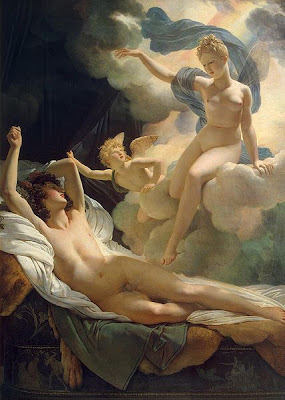
Guerin, "Morpheus & Iris" (1811)
So does virtue also vary according to the size/energetic strength of it's possessor and the angle through which it is viewed? That would certainly explain both the death of Semele and 1 Corinthians 13:12, which contains the phrase βλεπομεν γαρ αρτι δι εσοπτρου εν αινιγματι', which is rendered in the KJV as "For now we see through a glass, darkly."
SOCRATES: Well, I will try and explain to you what figure is. What do you say to this answer?—Figure is the only thing which always follows colour. Will you be satisfied with it, as I am sure that I should be, if you would let me have a similar definition of virtue?
MENO: But, Socrates, it is such a simple answer.
SOCRATES: Why simple?
MENO: Because, according to you, figure is that which always follows colour.
(SOCRATES: Granted.)
MENO: But if a person were to say that he does not know what colour is, any more than what figure is—what sort of answer would you have given him?
SOCRATES: I should have told him the truth. And if he were a philosopher of the eristic and antagonistic sort, I should say to him: You have my answer, and if I am wrong, your business is to take up the argument and refute me. But if we were friends, and were talking as you and I are now, I should reply in a milder strain and more in the dialectician's vein; that is to say, I should not only speak the truth, but I should make use of premises which the person interrogated would be willing to admit. And this is the way in which I shall endeavour to approach you. You will acknowledge, will you not, that there is such a thing as an end, or termination, or extremity?—all which words I use in the same sense, although I am aware that Prodicus might draw distinctions about them: but still you, I am sure, would speak of a thing as ended or terminated—that is all which I am saying—not anything very difficult.
MENO: Yes, I should; and I believe that I understand your meaning.
SOCRATES: And you would speak of a surface and also of a solid, as for example in geometry.
MENO: Yes.
SOCRATES: Well then, you are now in a condition to understand my definition of figure. I define figure to be that in which the solid ends; or, more concisely, the limit of solid.
MENO: And now, Socrates, what is colour?
SOCRATES: You are outrageous, Meno, in thus plaguing a poor old man to give you an answer, when you will not take the trouble of remembering what is Gorgias' definition of virtue.
MENO: When you have told me what I ask, I will tell you, Socrates.
SOCRATES: A man who was blindfolded has only to hear you talking, and he would know that you are a fair creature and have still many lovers.
MENO: Why do you think so?
SOCRATES: Why, because you always speak in imperatives: like all beauties when they are in their prime, you are tyrannical; and also, as I suspect, you have found out that I have weakness for the fair, and therefore to humour you I must answer.
MENO: Please do.
SOCRATES: Would you like me to answer you after the manner of Gorgias, which is familiar to you?
MENO: I should like nothing better.
SOCRATES: Do not he and you and Empedocles say that there are certain effluences of existence?
MENO: Certainly.
SOCRATES: And passages into which and through which the effluences pass?
MENO: Exactly.
SOCRATES: And some of the effluences fit into the passages, and some of them are too small or too large?
MENO: True.
SOCRATES: And there is such a thing as sight?
MENO: Yes.
SOCRATES: And now, as Pindar says, 'read my meaning:'—colour is an effluence of form, commensurate with sight, and palpable to sense.

So does virtue also vary according to the size/energetic strength of it's possessor and the angle through which it is viewed? That would certainly explain both the death of Semele and 1 Corinthians 13:12, which contains the phrase βλεπομεν γαρ αρτι δι εσοπτρου εν αινιγματι', which is rendered in the KJV as "For now we see through a glass, darkly."
Saturday, June 4, 2011
Living on the Threshold of Virtue and Vice

Plato, "Charmides"
Then once more, Charmides, I said, fix your attention, and look within; consider the effect which temperance has upon yourself, and the nature of that which has the effect. Think over all this, and, like a brave youth, tell me—What is temperance?
After a moment's pause, in which he made a real manly effort to think, he said: My opinion is, Socrates, that temperance makes a man ashamed or modest, and that temperance is the same as modesty.
Very good, I said; and did you not admit, just now, that temperance is noble?
Yes, certainly, he said.
And the temperate are also good?
Yes.
And can that be good which does not make men good?
Certainly not.
And you would infer that temperance is not only noble, but also good?
That is my opinion.
Well, I said; but surely you would agree with Homer when he says,
'Modesty is not good for a needy man'?
Yes, he said; I agree.
Then I suppose that modesty is and is not good?
Clearly.
But temperance, whose presence makes men only good, and not bad, is always good?
That appears to me to be as you say.
And the inference is that temperance cannot be modesty—if temperance is a good, and if modesty is as much an evil as a good?
All that, Socrates, appears to me to be true; but I should like to know what you think about another definition of temperance, which I just now remember to have heard from some one, who said, 'That temperance is doing our own business.' Was he right who affirmed that?
You monster! I said; this is what Critias, or some philosopher has told you.
Some one else, then, said Critias; for certainly I have not.
Cover Me Over!
There's nothing better in the world, Cyrnus, than a father and mother who care for holy Right.- Theognis of Megara (131-132)
Thursday, June 2, 2011
Mixing Metaphors - Medicine v. Commerce


Subscribe to:
Posts (Atom)